Friday, February 11, 2022

When the Cookie Crumbles


 When the Cookie Crumbles

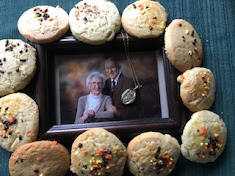
 Last week, my husband, who barely knows how to fry an egg, asked me to teach him to bake cookies. So we lined up ingredients, and he rolled out a tasty batch of Cream cheese sugar cookies. This week, Bill wanted to make his grandmother’s sugar cookies.

 We cut the recipe to five instead of 10 cups of flour (thank goodness). After measuring, mixing, rolling and baking, several dozen decent-looking sugar cookies line the counter. So we sit back to enjoy a warm cookie. Ahhhh. No! Arrgh! Something tasted off!

 Might it have been the two-years-out-of-date dry buttermilk I gave him to use? They only put those dates on products so you buy more. Right? Buttermilk is nothing more than sour milk, so what can go wrong with a can nestled in my refrigerator for several years?

 As I scooped them into the wastebasket, Bill said, “At least save a few to eat with coffee. That might help the taste.”

 We are now in our 61st year of marriage. For Valentine’s Day, I’d like to share some ideas with you young ‘uns about what has kept our love light burning through the centuries . . . in spite of sour buttermilk.

 We learned to rely on each other. We both graduated college at the same time, and we had married a year earlier. The first place we interviewed for teaching jobs said because we might have differences and students might sense tension, they wouldn’t hire us.

 Then the superintendent of schools from Alexandria, Virginia, came to Bloomsburg State College to interview. He said our marriage would be no problem. We wouldn’t see each other. I taught at a high school, and Bill taught in a trailer outside an eighth grade school with 800 students.

 Immediately after we graduated, we loaded our car with those wonderful wedding gifts and off we went, three hours from home, to teach summer school. So those first years of marriage we couldn’t go running home to mama when we had a spat. We, who grew up in a rural area, were alone in a big city with one car. You bet, we learned to rely on each other.

 We learned to allow separate interests and find similar ones. Bill likes hunting, sports and woodworking. I like to read and write. But we sit side-by-side to solve jigsaw and Sudoku puzzles.

 We learned to give each other space and grace. When we’re pursuing our separate interests, we like to be alone. But if Bill “visits” my office when I’m writing, that’s fine too. And vice versa, if I interrupt his woodworking.

 We learned to help each other out. I help him find things in the refrigerator. He finds everything I lose, even the back of an earring in a cardboard newspaper box in the garage—months after I lost it.

 We learned to rub our feet and walk on when we stepped on each other’s toes.

 We learned not to criticize each other for mistakes (see opening story).

 I learned I am not always right (see opening story).

 I treasure the pendant Bill gave me for my last birthday. The engraving on the back reads: Shirley, I loved you then, I love you still. I always have, I always will. William.

 We’ve learned to treasure each day the Lord gives us. Life becomes more fragile as you age, and suddenly heaven awaits. But you want to see grandchildren marry and cuddle great-grandchildren. You want to write another book, build another birdhouse. There’s always something that makes you want to live on. And that’s good. But we know life’s going to end.

 So we do our best to leave a legacy of grace and faith, and we wish the same for you.

 Happy Valentine’s Day!


Friday, January 21, 2022

Are You Stalled Because of Overload?


Do you ever feel overwhelmed? I do. And I suspect you do too. Especially if you’re a young mother and picking up after kids never ends. Especially if you work outside the home and caught between raising kids and caring for parents. Especially if you are older and can no longer care for yourself, your spouse and your home.

One of the things that overwhelms me is the diet my husband’s health requires. There are too many details to remember. He may eat graham crackers . . . and doughnuts. But he may not have pumpkin pie.  He may have canned peaches but not fresh peaches. Besides that, my husband has no appetite. Except for pumpkin pie and fresh peaches. Well, not really. But pretty close. This all overwhelms me.

Both my husband and I have health conditions that limit the amount of work we can do; therefore, cleaning defeats me. I cannot vacuum the bedroom, kitchen, dining room, living room and sunporch in one session. So I don’t vacuum at all. I cannot wipe down the kitchen cabinets in one session, so I don’t wipe them down at all.

The demands of Christianity sometimes defeat me. I read a devotion on being kind, hear a Sunday school lesson on prayer and listen to a sermon on watching your tongue. I can’t possibly remember to do all three, so I just forget about them all.

How can we do better?

First, we may need to change our attitudes. Just because we can’t do it all, doesn’t mean we can’t do any of it. Lowly pansies are as pretty as big showy zinnias. And accomplishing one small task feels as good as accomplishing one large one. And in time, the small tasks add up to a large one. With a little planning and God’s help, we can accomplish our goals.

We may also seek and accept help. A dietician is available for consultation regarding my husband’s diet. I can ask why it is that along with unsalted pretzels and graham crackers, my husband may eat doughnuts. And may he eat all kinds of doughnuts—cream filled, raised, glazed or his favorite—iced with coconut and a cherry on top? If we need help to clean the house, we can train children (and husbands) to pitch in. Or we may utilize a cleaning service.

We can take charge of our schedules, instead of letting the hours and days and weeks slip by. In my case, I need to plan small tasks in manageable time periods. This morning I will vacuum the living room and sun porch. Period. With my husband’s input, I will plan one day or even one meal around the diet plan rather than try to plan forever-after.

And finally, we can pick and choose. Of the spiritual input I receive, there are always some areas of my life that need more attention than others. I can ask God where my focus needs to be. God never expects us to do life without Him. That’s why He sent His Holy Spirit to be with us. And in all these areas, God will help and direct me: “I can do all this through him who gives me strength” (Philippians 4:13 NIV).

So let’s say our prayers and go to bed with a clear conscience. We may not have done all we would, but we have done all we could. And that is all God asks of us.


Friday, December 17, 2021

Be Careful Little Eyes How You Read


Because of my husband’s illness, we bought an oximeter, a gadget you snap onto your finger to read your oxygen level. My husband’s level read 90. I then clipped the oximeter onto my own finger and looked down. It showed 86. (Read the top number in first photo and bottom number in the second.)

 That alarmed me. I had heard anything below 89 was cause to head to the emergency room. But I felt fine, so I decided just to keep tabs on it. An hour later, I had the same oxygen level. But that afternoon when I checked it, instead of looking down at the back of my open hand to read the device, I turned my hand over and folded my fingers back toward me. And my level was 98.

 What I was reading as 86 was actually 98. I had been reading the oximeter upside down.

 And we may misread scripture as well. We live in the 21st century, reading Scripture written almost two millenniums earlier in a very different culture. And we read with finite minds, while God, the Author, is an Infinite Being.

 “For my thoughts are not your thoughts, neither are your ways my ways,” declares the Lord” (Isaiah 55:8).

 Some common misconceptions about interpreting Scripture exist. But we can compare Scripture to Scripture, consult online commentaries and discuss our questions with pastors, Sunday school teachers and mature Christians.

 For one thing, we may interpret having the abundant life Jesus spoke of as being healthy, wealthy and smart. But we must always look at the whole of Scripture. Jesus also said that in this life we will have trouble. But even then we experience the abundant life because He has overcome the world (John 16:33) and He walks with us.

 Early Christians suffered persecution, yet they rejoiced they had been “counted worthy of suffering disgrace for the name” (Acts 5:41). God uses struggles to build character, and we encourage others as we share how God helped us through our personal struggles.

 Many men and women have given their very lives for the cause of the gospel. Stephen was stoned to death. Paul and others were imprisoned and many, if not all, of the disciples became martyrs. Hardly living the “healthy, wealthy and smart” life.

 “The blood of the martyr is the seed of the church” is attributed to Tertullian, an early Christian author. Rather than put an end to the spread of the gospel, the death of martyrs inspired others to take their places, and the church grew. God uses even evil for good.

 Another way we misread Scripture is to think that because “slaves” are mentioned, God approves of slavery. But in those days, “slaves” were well treated and cared for, almost as members of the household. Not so with slavery as we know it.

 Then there’s the issue of women. You might say Old Testament women were considered “second-class citizens.” Men could divorce wives for most anything that displeased them. Traditional Jewish rabbis started their day praying, “Blessed are you, Lord, our God, ruler of the universe who has not created me a woman.”

 In New Testament times, Jesus respected and elevated the status of women by including them in His ministry. He allowed Mary to sit at His feet for teaching, and women traveled with Him. After His resurrection, He appeared first to a woman.

 However, since Paul said women should be “submissive” (1 Corinthians 16:16), some assume women must accept ill treatment without refute. But Paul may have been using sarcasm to correct a problem of the Corinthian church where women distracted from sermons by calling out questions.

 These examples show that just like my incorrect reading of my oximeter, I may misread Scripture as well. From the comfort of my easy chair, I may think the gospel is about me inviting God into my world so that I can enjoy the good life. But the more I read, it’s really about God inviting me to get out of my easy chair to join Him in His work. But first, I must properly understand His Word.

 We need the whole of scripture to inform our faith instead of picking and choosing verses that suit our purposes. When we all get to heaven, we may be surprised at the many ways we drew wrong conclusions here on earth.
 

Saturday, November 27, 2021

Finding the Missing Peace of Christ


During this pandemic, my husband and I have spent hours hunched over jigsaw puzzles. One depicted Fallingwater, a home designed by Frank Lloyd Wright to blend with nature. And the puzzle pieces surely did blend. We toured Fallingwater with our family to celebrate our fiftieth anniversary, so that national historic landmark holds a special place in our hearts.

Jigsaw puzzles force me to pay attention to detail. But even when I do, I get things wrong. For instance, I “knew” this one piece had two ends of orange with a strip of green through the middle. I worked my way around the scattered puzzle pieces at least six times looking for that particular piece.

Guess what? When I studied the puzzle more closely, I discovered that one whole end of the piece was green, not just the middle. I had looked for the wrong color.

Isn’t that how it is with life? We hunger for peace, but too often we think the feeling of satisfaction will bring us peace. For instance, television commercials convince us we to buy a new car. But then we buy a new car, and in a month it’s a used car. It didn’t bring us the peace we sought.

That’s all because only one thing will bring us true peace, and that’s Christ Himself.

Once we achieve peace with God, all other things fall into place. At least, so they say. But how does that actually work?

Well, it takes work. So I consider, what disturbs my peace? And how do I regain it?

Physical issues. Pain, sickness, discomfort. They usually strike in the middle of the night. So I do what I can to deal with them: Take a pill. Call a doctor. Call an ambulance. It all depends on the severity. I may read an inspirational book or Psalms. And I pray.

National issues. COVID, crises, crucial issues. I feel helpless. So I do what I can to deal with them: Write an opinion piece for a newspaper. Encourage others through online devotionals. Draw strength from historical events in scripture. Kings ruled in Israel for many years. David and Solomon, godly kings, each reigned 40 years. Manasseh, an evil tyrant, reigned 55 years. Good kings. Bad kings. Yet God remained faithful to His people. And He will surely remain faithful to us regardless of national unrest.

Spiritual issues. Doubt, unrest, questioning God. So I do what I can to deal with them: First of all, I am in Christ, which gives me peace with God. I don’t just know about Christ. I don’t just read about Christ. I’ve invited Him to be Lord of my life, and I try to live for Him and represent Him well. I’ve heard being “in Christ” described like being in a room. You are either present there or not. You don’t just know about the room or read about the room. You are either there or you’re not.

And if I am in Christ, He is with me, He is for me and He sends His Holy Spirit to guide me. He may invite me to pray, to be still and know that He is God. He may guide me to encouraging passages of scripture or to a pastor or mature Christian who might answer my questions. Christ truly is the Prince of Peace.

So today, as I deal with various challenges, I will find peace by trying to pray without ceasing and looking for Christ at work in the details of life. “If you look for me in earnest, you will find me when you seek me” (Jeremiah 29:13 NIV).


Friday, November 5, 2021

Too Soon Oldt And Too Late Schmart


            One of the dumbest things I ever did was to try to flush a disposable diaper down the toilet. Hey, it was the sixties, and disposable diapers had just come on the market.

            Of course the toilet overflowed. And of course I knew not how to stop the rising water in the toilet bowl, which ruined the paint on the kitchen ceiling below. Fortunately, Mrs. Heckert was an understanding landlady.

            Now you may wonder how I could have done something so stupid. Well, I simply did not know. And there’s a lot more I don’t know . . . about God and the world and life in general.

            For instance, I don’t know what happens when I ask my phone a question and a woman immediately answers. Where is this woman? How does she look up the answer so fast?

I don’t know how email messages fly around the world in seconds. I don’t know how hummingbirds fly thousands of miles flapping their little wings. Do they ever get tired? I don’t know how sheep know the voice of their shepherd. I don’t know how COVID began.

            But there are some things I do know, and with that knowledge, I live my life.

            --I know God gives me friends to support me on my journey, and I appreciate them.

--I know that God helps people survive all kinds of challenges. They suffer. But God is faithful to them. And He will be faithful to me.

            --I know Jesus heals our hurts, and we pass on His comfort to others.

--I know that when discouraged I can to look back to see where God has been faithful in the past. That helps me trust Him in the present.

            --I know God created the world and everything in it—including me. “In the beginning God created the heavens and the earth” (Genesis 1:1 NLT). Look up at the stars on a clear night. Consider the way a human body works. How could things so complex happen without a Creator?

-- I know Christ came to live and die to fulfill the demands of a perfect God to sacrifice a perfect life. Only when we accept Christ’s holiness are we fit enough for heaven.

--I know God numbered our days. The death rate is 100 percent. So I want my life to be well lived—and ready for heaven.

So, like that Pennsylvania Dutch saying in the title (we get old too soon and smart too late), I do my best to live my life in tune with Jesus as my Savior, seeking the guidance of the Holy Spirit and knowing our Triune God is on His throne. And I trust Him. Even when I do dumb things.